
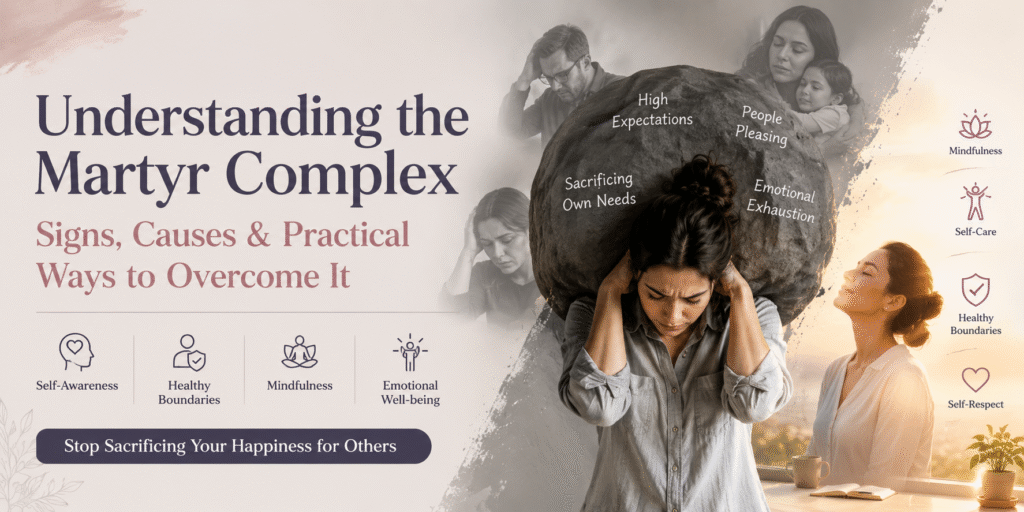
Many of us have fallen prey to the martyr complex, either we ourselves have it or a loved one does. Martyr complex is when an individual seeks suffering and undergoes great troubles for the assumed benefit of others. They tend to sacrifice their own happiness because they think this is the only way for their loved ones to be happy and satisfied. In such a case, people who assume the martyr role have deep-seated problems related to confidence, poor self-care, low assertiveness, dissatisfaction with their own lives and resentment towards others.
The martyr complex is deeply rooted in many cultures and families. Individuals learn early in their lives that they need to let go of their own wishes to please their loved ones. This gives them a sense of validation and importance where others rely on them to a large extent.
This tendency can lead the martyr to experience
- Unhappiness due to poor self-care
- High expectations from others to rise up to their levels and invariably fail
- Anxiety to please others
- Poor interpersonal relationships
- Being highly strung and constant alertness to search for things to do for others
- Anger and blame towards others and self
- Feeling victimised at having to sacrifice their needs.
The loved ones are also likely to experience similar mental health and interpersonal problems due to poor communication, high expectations, anger outbursts and confusion. Martyrs are likely to behave in a rather unhealthy manner, leading their loved ones to experience emotional trauma.
Martyr complex leads people to behave in a highly passive or aggressive manner, depending on their past experiences, conditioning and personality factors. Also, they have poor awareness of their own physical and emotional needs. Sometimes, they may be good providers for their loved ones, thus getting further validation for their unhealthy behavioural patterns. But, in spite of the validation, there is a deep-rooted dissatisfaction.
In order to bring about cognitive, emotional and behavioural changes – mindfulness and assertiveness can be of great help.
- Mindfulness – this technique helps us stay focused on the present, and helps us understand who we are and what we need, thereby bringing about a sense of calmness and control over our own lives. Mindfulness helps us manage stress and overthinking. We can break our old unhealthy habits and find healthier ways to manage our situations, where the outcomes are likely to be different and better. This deeper self-understanding can also instill a sense of confidence and self-validation rather than constantly depending on others for validation. Also, the realization that nobody has to be a victim unless they really are, will help individuals to have more pro-self and pro-health thoughts, emotions and behaviors.
- Assertiveness – it is a communication technique where the individual learns to express their thoughts, feelings, needs and ideas in a calm and open manner which is respectful towards both themselves and others. The initial step towards being assertive is to know what we want and need, and then to communicate it to others. Assertiveness skills can be used to set healthy boundaries with family, friends and co-workers. It may include aspects of our lives like saying “no” politely when needed, asking for help, handling criticism, handling compliments etc.
With strong self-understanding and communication, the martyr complex can be well managed, leading to better personal satisfaction and improved interpersonal relationships.
Recent Comments